【Pillar of Shame Must Not Be Forfeited: Creator Jens Galschiøt Calls on Hong Kong Court to Determine Ownership and the Legal Basis for Forfeiture】
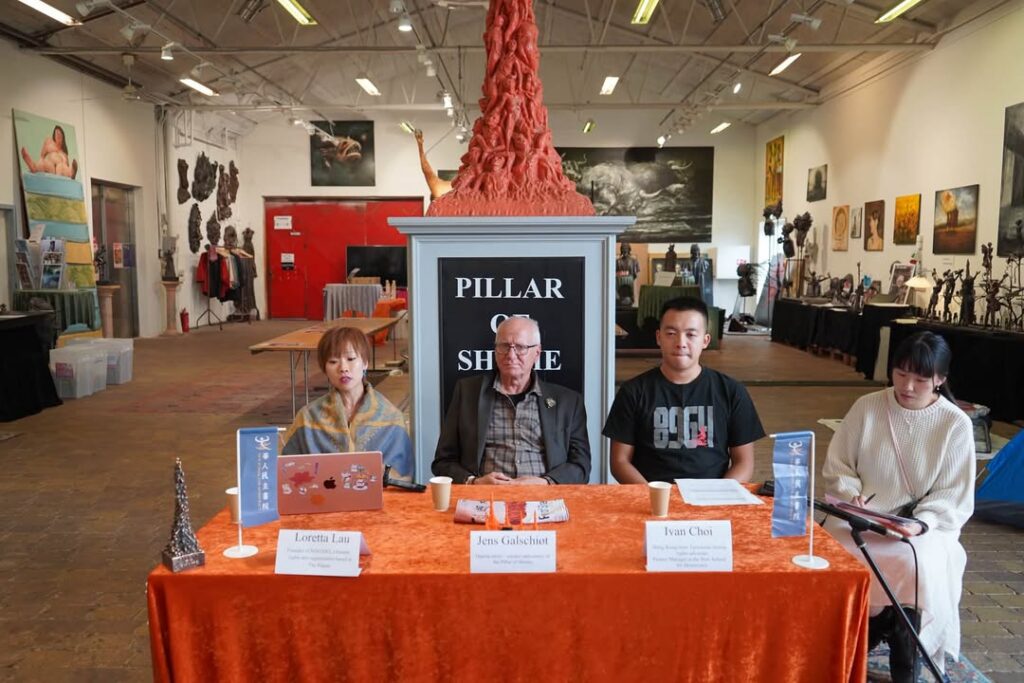
On 10 September, the New School for Democracy held a press conference at Gallery Galschiøt in Odense, Denmark, in response to the prosecution’s application to forfeit the Pillar of Shame and other exhibits in the Hong Kong Alliance case.
The speakers, in order of appearance, were:
1. Jens Galschiøt – Danish sculptor and creator of the Pillar of Shame
2. Ivan Choi – Project Manager, New School for Democracy
3. Loretta Lau – Founder, NGO DEI
Our position is clear. The Pillar of Shame is an artwork commemorating the victims of the June Fourth crackdown and a historical record of state violence. It is neither a weapon nor an instrument of crime.
Before the Court makes any irreversible order, two questions must be properly determined:
Who owns the Pillar of Shame?
What is the legal and evidential basis for forfeiting it?
On 21 August 2026, Hong Kong’s Court of First Instance convicted the now-disbanded Hong Kong Alliance in Support of Patriotic Democratic Movements of China, Lee Cheuk-yan and Chow Hang-tung of incitement to subversion. Albert Ho had previously pleaded guilty to the same charge.
Mitigation proceedings concluded on 28 August. Lee Cheuk-yan, Albert Ho and Chow Hang-tung could each face a maximum sentence of ten years’ imprisonment.
Following mitigation, the Hong Kong Department of Justice applied for the forfeiture of exhibits connected with the case. These included books, display panels, postcards and other historical materials seized from the June 4th Museum, as well as the Pillar of Shame.
The prosecution argued that annual washing ceremonies involving the Pillar were connected with the call to “end one-party dictatorship” and characterised the sculpture as a “tool” used in the commission of the alleged offence.
The first speaker, Jens Galschiøt, reaffirmed that he created the Pillar of Shame, never transferred its legal ownership to the Hong Kong Alliance, and does not consent to its forfeiture, confiscation, destruction, disposal or transfer.
Galschiøt said:
“The Pillar of Shame belongs to me, and its ownership is clear. I have formally requested its return. It is an artwork commemorating the victims of the June Fourth crackdown. It should not be treated as an instrument of crime, nor should it be forfeited or destroyed without the ownership issue first being properly determined.”
Galschiøt’s ownership claim did not arise in response to the current forfeiture application.
In 2021, when the University of Hong Kong sought to remove the sculpture from its campus, Galschiøt and his representatives informed HKU that he claimed ownership and wanted it returned. Communications concerning its collection continued after HKU dismantled the Pillar in December 2021 and placed it in storage.
The second speaker, Ivan Choi, Project Manager of the New School for Democracy, said:
“The Hong Kong authorities first prosecuted the people who protected the memory of June Fourth. They are now attempting to confiscate the artwork that carries that memory. The Pillar of Shame is not a weapon. It is not a tool of crime. It is an artwork, a memorial and a record of state violence.”
Choi stressed that the case concerns more than the ownership of a single sculpture. It raises the broader question of whether Hong Kong’s national security system is being used to redefine art, commemoration and historical memory as elements of a criminal offence.
If a sculpture commemorating the victims of the June Fourth crackdown can be treated as an instrument of crime merely because it appeared in public memorial activities, the consequences for artistic freedom, historical preservation and public memory in Hong Kong will be extremely dangerous.
For many years, Hong Kong citizens gathered around the Pillar to commemorate the victims of June Fourth and preserve a history that the Chinese authorities have sought to suppress.
Removing the sculpture, prosecuting those who preserved that memory, and attempting to forfeit the artwork cannot erase the history of June Fourth or extinguish Hong Kong people’s desire for freedom.
The third speaker, Loretta Lau, founder of NGO DEI, focused on the ownership dispute and the legal questions raised by the prosecution’s attempt to obtain permanent forfeiture of the sculpture.
On 18 January 2023, Lau travelled to Hong Kong on Galschiøt’s behalf. She delivered written requests concerning the return of the Pillar to the University of Hong Kong, including the Kadoorie Centre, where the sculpture was being stored, as well as the Estates Office and the President’s Office.
On 5 May 2023, officers from the National Security Department of the Hong Kong Police Force seized the Pillar from HKU pursuant to a court warrant and described it as an exhibit connected with an incitement-to-subversion case.
According to Lau, the authorities did not tell Galschiøt which specific case they were referring to.
Lau stressed that this chronology is crucial. Galschiøt had asserted ownership and was actively seeking the return of the Pillar before the police seizure. His claim therefore cannot be dismissed as a new argument raised only because the prosecution is now seeking forfeiture.
Lau said:
“Seizing an object and retaining it as evidence is legally different from permanently forfeiting it at the conclusion of proceedings. The fact that an object has been used as evidence does not, by itself, determine who owns it or establish that it should be permanently forfeited.”
The Pillar was independently created by Galschiøt many years before the conduct alleged by the prosecution and had been publicly displayed in Hong Kong since 1997.
It is not contraband. It was not created, purchased or acquired with the proceeds of crime.
If the prosecution argues that later activities involving an existing artwork are sufficient to make the artwork itself subject to forfeiture, it should identify the applicable legal basis and establish the connection required by law.
The prosecution has suggested that the Pillar was given to the Hong Kong Alliance. Galschiøt disputes this and is prepared to submit documents and evidence concerning his ownership and previous attempts to recover the sculpture.
As a third party claiming ownership of property that the prosecution now seeks to forfeit, Galschiøt should be given a reasonable opportunity to place his evidence before the Court and respond to any assertion that ownership was transferred to the Hong Kong Alliance.
The press conference also addressed why Galschiøt cannot reasonably be expected to travel to Hong Kong personally.
Following the seizure of the Pillar in May 2023, reports indicated that he could face arrest if he entered Hong Kong. He sought clarification from the authorities but received no assurance that he could enter without arrest.
His decision not to travel to Hong Kong should not be interpreted as abandonment of the sculpture.
Galschiøt can authorise a professional art handler or international shipping company to inspect, pack, collect and transport the Pillar safely to Denmark. He is prepared to provide the necessary written authorisation and any reasonable supporting documentation.
The New School for Democracy and the participants in the press conference jointly call for the following:
1. The ownership of the Pillar of Shame must be properly determined before the Court authorises any irreversible action.
2. The prosecution must identify the specific legal and evidential basis for forfeiture. The sculpture’s appearance in a video or involvement in commemorative activities does not, by itself, establish that it was an instrument of crime.
3. Jens Galschiøt, as a third party claiming ownership, must have a reasonable opportunity to submit documents and evidence and respond to any assertion that ownership was transferred to the Hong Kong Alliance.
4. Until the ownership dispute and forfeiture application are finally resolved, the Pillar must remain intact and properly preserved. It must not be destroyed, damaged, disposed of or transferred.
5. If Galschiøt is established as the owner and there is no lawful basis for continued detention or forfeiture, the Pillar should be released to his authorised representative and professionally transported to Denmark.
6. The same principles must apply to the books, display panels, postcards and other historical materials seized from the June 4th Museum. The prosecution should identify the legal basis for forfeiting each individual item.
Preserving the Pillar of Shame is not only about protecting an artwork. It is also about safeguarding the historical record of June Fourth, the collective memory of Hong Kong, and the right of artists and citizens to document state violence.
Until the ownership claim and the legal basis for forfeiture have been fully and fairly determined, the Pillar of Shame must remain intact and properly preserved.