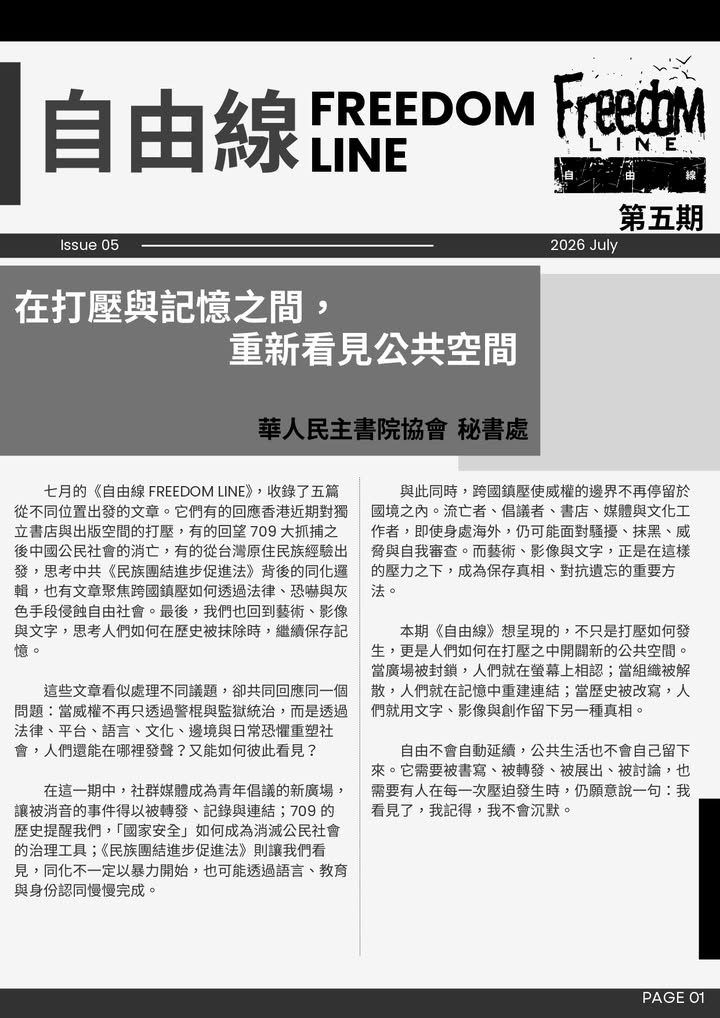
Issue 05 of the New School for Democracy’s newsletter Freedom Line is out. The following summary is the association’s own.
Summary of Freedom Line Issue 05
Freedom Line Issue 05 explores how civil society responds to political repression, historical erasure, and the shrinking of public space. Through essays and reflections from activists, writers, artists, and civil society observers, this issue examines how authoritarian power extends beyond borders while individuals and communities continue to preserve memory, defend freedom, and create new spaces for public expression.
The opening section introduces the central theme of this issue: how people can reclaim public space when traditional spaces for civic participation are increasingly restricted. The articles show that repression today operates not only through arrests and imprisonment, but also through laws, censorship, surveillance, language, cultural assimilation, and transnational pressure. At the same time, writing, art, independent publishing, and social media have become important ways of preserving memories that might otherwise disappear.
One article examines China’s Ethnic Unity and Progress Promotion Law, arguing that policies presented in the language of ethnic unity may further marginalize minority languages, cultures, and identities. Another article looks back at the transformation of Chinese civil society following the 709 Crackdown, describing how national security laws, restrictions on lawyers and NGOs, digital surveillance, and other legal mechanisms have gradually reduced the space available for independent civic activity.
Art, photography, and writing are also presented as forms of resistance to forgetting. Through exhibitions and cultural projects involving Hong Kong and Taiwanese artists, contributors explore how images and creative works can preserve suppressed histories and reconnect communities across borders. These cultural spaces provide alternative sites of memory when official institutions are unable or unwilling to do so.
The issue also examines how social media has become a new public square for younger generations. When physical gatherings are restricted or dispersed, online communities can document events, share information, organize support, and preserve records that might otherwise be erased. Although accounts and posts can be censored, new networks and forms of communication continue to emerge.
Another article addresses the growing problem of China’s transnational repression, particularly its impact on Hong Kong activists and dissidents living overseas. It argues that intimidation, surveillance, legal pressure, and threats increasingly cross national borders, creating challenges not only for individuals in exile but also for democratic societies seeking to protect civil liberties.
The issue concludes by remembering Lam Wing-kee, founder of Causeway Bay Books. His experience represents both the vulnerability and resilience of independent publishing under authoritarian pressure. His commitment to books, freedom of expression, and historical memory reminds readers that preserving knowledge can itself become an act of resistance.
Overall, Freedom Line Issue 05 argues that public space does not disappear completely under repression — it changes form. Through books, art, writing, social media, and collective memory, people continue to find ways to speak, connect, and resist enforced forgetting.
Contributors to this issue: Yapasuyongu Akuyana (陳旻園), Yu Pin-chien (玉品健), Silver Wong, Han Ping-chu (韓秉燭), and Kang Chun-ming (康駿銘).
A note for English readers: the summary above is the English text the association publishes for this issue. The issue itself — ten pages of essays and reflections — is written in Chinese and has not been translated, so the summary is the complete English version rather than an introduction to something longer you can read.
The issue on Substack (in Chinese): Freedom Line Issue 05