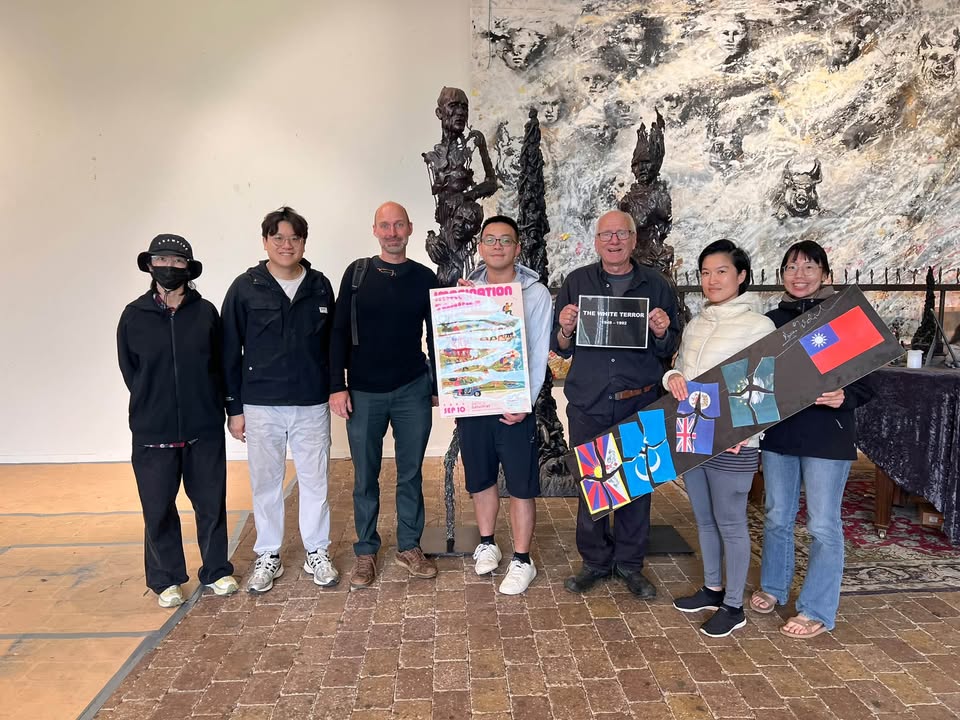
On 10 September 2026, the closing presentation of “IMAGINATION TAIWAN,” jointly organised by the New School for Democracy Association and Galleri Galschiøt, was held at the Galschiøt studio and gallery in Odense, Denmark. More than 80 guests attended, and Danish local media came to interview the artists.
The event centred on Taiwanese food, interactive theatre, music, painting, installation art and community co-creation. Through a multi-sensory, immersive format, it invited Danish audiences to begin from everyday experience and understand how deeply Taiwan values freedom, democracy and the right to choose. Its central message was this: freedom is not an abstract concept. It lives in food, language, memory, cultural expression, and in each person’s right to determine their own future.
**Year two of a ten-year partnership: from exhibition to immersive exchange**
The event marked the second year of the Taiwanese artist exchange programme that the New School for Democracy Association and Danish artist Jens Galschiøt have pursued since signing a ten-year memorandum of understanding in 2025.
Where the first year focused on individual exhibitions and the launch of the partnership, this year developed into an immersive presentation combining food, theatre, music, painting, installation and public art. The participating artists lived, learned and created together in Denmark, exchanging with local artists, residents and children, and bringing Taiwan’s cultural memory, democratic experience and contemporary social issues into Danish public space.
**It began with a meal voucher: experiencing freedom and choice through food**
The event opened with an immersive experience and a tasting of Taiwanese food. Each guest received a meal voucher on arrival. Four Taiwanese dishes were available — egg crêpe, salted chicken, braised pork rice and aiyu jelly — but each guest could choose only three.
This deceptively simple arrangement used the most ordinary of experiences, eating, to convey a central idea: that life can be chosen, and must be chosen. At the aiyu stall, participants were invited to wash the aiyu seeds by hand; the other stalls drew long queues, and the egg crêpes were claimed within minutes.
Through taste and direct participation, Danish audiences not only encountered Taiwanese food culture but experienced, from the very start of the event, the seemingly ordinary yet precious relationship between choice and freedom.
**Opening remarks: connecting Taiwan, the Nordic region and democratic values through art**
Danish artist Jens Galschiøt, Ambassador Cheng Jung-chun, Representative to Denmark, and Wu Wen-hsuan, adviser to the Taiwan Association in Sweden, each spoke at the event, addressing artistic exchange between Taiwan and the Nordic countries, Taiwan’s international participation, and how democratic societies can jointly confront authoritarian threats.
**Jens Galschiøt: art is a vital force against injustice**
Galschiøt reflected on the exchange throughout the workshop and commended the Taiwanese artists for responding to public issues through a range of artistic forms. Art, he said, should not be separated from social reality; it can be a vital force in resisting injustice, defending freedom and fostering international understanding. He encouraged the Taiwanese artists to keep creating and to carry Taiwan’s stories and democratic experience to more places.
In an interview after the event, Galschiøt said that compared with last year’s exchange, this year’s presentation was more coherent and integrated. Taiwanese food, interactive theatre, music, painting, installation works and community co-creation echoed one another, allowing audiences to understand Taiwan more deeply through different senses and through everyday experience.
**Ambassador Cheng Jung-chun: making Taiwan’s cultural diversity and democratic values visible**
Ambassador Cheng Jung-chun thanked Galschiøt for providing an invaluable creative environment and platform for international exchange, one that allowed artists from Taiwan to live, learn and create together and to present Taiwan’s cultural diversity and democratic values to Danish society through a range of artistic forms.
He closed his remarks by saying:
“Taiwan is worth defending, and worth fighting for. Let us continue to work together, and prove once again that democracy delivers.”
**Wu Wen-hsuan: Taiwanese culture has a diverse and distinct identity of its own**
Drawing on years of work promoting Taiwan’s international participation, Wu Wen-hsuan, adviser to the Taiwan Association in Sweden, said that Taiwanese people have a responsibility to stand up for justice, truth and universal values:
“We have always worked for Taiwan’s international visibility. We are all born with a mission, and that is to stand up for justice, truth and universal values.”
Wu also stressed that Taiwan’s history, peoples and cultures are diverse, and cannot be reduced to an extension of Chinese culture:
“Taiwan is not China. Chinese culture is part of Taiwanese culture, but Taiwan also has the Amis, the Seediq and many other Indigenous peoples, as well as its own local culture and Hakka culture. Chinese culture is only one part of Taiwan.”
**Interactive theatre, FREEDOM-FREE™: when freedom is packaged as a benefit**
After the opening remarks, the artists performed the interactive theatre piece FREEDOM-FREE™. The story originated in a picture book being created by the artist JULIA; it was adapted by theatre director Monique Wu and then developed collaboratively by the workshop artists into the interactive performance presented that day.
Minnie Lee played the lead role, while Monique Wu served as both director and narrator, guiding the audience step by step into the totalitarian world of the story.
**Absurdity as a way of showing how freedom is taken away**
FREEDOM-FREE™ is set on a small island taken over by a new government. The new regime renames the country a “region” and introduces a national welfare programme that promises to relieve its people of choice and of freedom.
Through dark humour and absurdist narrative, the work shows how freedom can be stripped away step by step, in political language that appears to have the people’s interests at heart.
The performance invited the audience to make choices in four scenarios:
* being permitted to say only one officially designated phrase;
* how to hide a forbidden strawberry discovered in one’s meal;
* being forced to relocate and allowed to take only a teddy bear carrying no political meaning;
* how to speak out when one’s own eyes are appropriated and used by competing political forces.
However absurd these scenarios appear, they show how totalitarian systems seep into daily life, gradually taking control of language, memory, choice and the right to define oneself — and they echo the threats and fears Taiwan faces in actual politics.
The performance ended with the line, “These are my eyes. See us, but do not define us for us” — a reminder that the international community, in paying attention to Taiwan, should also respect the right of Taiwanese people to speak for and define themselves.
**Music: preserving Taiwan’s cultural memory in melody**
Following the performance, musician Hsieh Sheng-Hung played Taiwanese classics including “Diu Diu Tong A” and “Rainy Night in the Harbour City,” expressing Taiwan’s cultural memory and attachment to the land through music.
Some Danish audience members remarked that certain traditional Taiwanese melodies bore an unexpected resemblance to Danish folk songs. Even across different languages, music could cross distance and become a bridge for cultural exchange between Taiwan and Denmark.
**Works by the Taiwanese artists: from cultural identity to freedom in practice**
Beyond the theatre and music, each participating artist completed a number of paintings in Denmark. The works draw on Taiwan’s culture, national identity, freedom and democracy, and social movements, and also record what the artists observed and felt while living, creating and exchanging together in Denmark.
Displayed together on the gallery walls in different sizes, media and styles, the works form a portrait of Taiwan woven from personal memory, political reflection and everyday imagination.
Through these paintings the artists respond to questions such as what Taiwan is, how freedom is practised, and how an individual locates themselves within politics and history. The works offer no single answer; instead they present Taiwanese society as diverse, complex and full of life.
**White Terror: linking historical memory to contemporary democracy through sculpture**
The event also presented once again Galschiøt’s White Terror, a work created on the subject of Taiwanese history. It consists of two upright metal sculptures, placed on either side of where Galschiøt spoke on the day of the presentation.
The two sculptures are composed of contorted, layered and elongated human forms. The bodies are entangled and pressed against one another, faces and limbs seemingly trapped within narrow columns, depicting individuals controlled, tormented and consumed by state violence. Their heavy, unsettling forms also stand for the scars that authoritarian rule leaves on the bodies of victims and in social memory.
**Understanding, through the White Terror, how hard-won Taiwan’s democracy is**
The work takes as its historical background the long period of martial law and political persecution from 1949 to 1987, when the Kuomintang government, after relocating to Taiwan, established authoritarian rule in the name of anti-communism and national security — a trauma in which large numbers of people were placed under surveillance, arrested, tried, imprisoned and even executed.
Through White Terror, Galschiøt brings Taiwan’s authoritarian history into Danish public view, in the hope that more people in Denmark and Europe will understand that Taiwan’s democracy and freedom today did not appear from nowhere. They were won by countless victims, political prisoners, human rights workers and participants in the democracy movement, through years of resistance and at a heavy cost.
White Terror also connects the contemporary work of the workshop to Taiwan’s history. As the Taiwanese artists used their work to address freedom, identity and contemporary authoritarian threats, Galschiøt’s two sculptures reminded audiences that Taiwan endured a long period of state violence — and that preserving historical memory is an indispensable part of defending democracy today.
**A community mural: bringing different voices together in public space**
The work of the workshop did not remain inside the studio and the gallery. The Taiwanese artists, together with Galschiøt, artists from the nearby creative community, local residents and children, completed a large outdoor mural.
The mural centres on two profiles facing one another, with two tongues extending from their mouths and knotting together in the middle, above the question “ARE WE TALKING?” The entangled tongues stand for people attempting to communicate, and for the tangles that differences in language, position and understanding can produce.
Around them, participants painted a multitude of faces and expressions, alongside text in Chinese, English and other languages. Some expressed happiness, anger, confusion or disagreement; others posed questions such as “what is freedom,” presenting each person’s own sense of emotion, communication, difference and free expression.
In the process of creating together, the boundaries between professional artists, local residents and children dissolved, and everyone could leave their own colour, language and voice on the wall. The mural is not only an outcome of the workshop but a symbol of the connection built between Taiwanese artists and the local Danish community.
We did not only bring Taiwan’s stories to Denmark; we created a shared public memory together with the local community.
**Ivan Choi: documenting protest, exile and political trauma**
Among the works on display, Ivan Choi presented a number of personal paintings along with the installations Escape Bag and The Road Tents We Once Lay On.
Drawing on his experience in the Hong Kong protests and his subsequent exile in Taiwan, the works depict the dangers protesters faced in the streets, the memory of being forced to leave home, and the way political trauma persists in everyday life.
Escape Bag recreates the items a protester must be ready to carry at a moment’s notice, reflecting the condition of exiles who cannot know when they will be able to return home. The Road Tents We Once Lay On uses tents, photographs, gas masks and objects from the street to preserve the bodily memory of the protest sites, and the experience of Hong Kongers looking out for one another and resisting under repression.
**Closing: refusing political manipulation, defending Taiwan’s subjectivity**
Near the end of the event, theatre director Monique Wu recalled the controversy over Copenhagen Zoo erasing Taiwan from a display map in order to welcome giant pandas from China. On stage she called out:
“Don’t be controlled by the panda!”
Wu urged Danish society not to be swayed by China’s panda diplomacy and political influence, and not to overlook Taiwan’s existence and subjectivity as a result. The remark drew enthusiastic applause.
**Audience response: freedom and choice are not to be taken for granted**
Audience members said that the everyday questions and interactions made it easier to feel that freedom and choice cannot be taken for granted, and easier to understand the real situation Taiwan faces amid international politics and authoritarian threats.
From choosing a dish, to taking part in the theatre scenarios, to viewing the artworks and painting the mural together, audiences were not passive recipients of a message. Through participation they were led to ask: who has the right to decide our language, our memory, our identity and our future?
**Deepening artistic exchange between Taiwan and the Nordic countries**
The New School for Democracy Association said that the event was not only an international platform for Taiwanese artists to present their work, but a democratic dialogue conducted through art, food and everyday experience.
Taiwan’s story should not exist only within discussions of geopolitics. It should be told by the people of Taiwan themselves, through their own culture, memory and creative work.
Entering the second year of the ten-year partnership, the New School for Democracy Association will continue to deepen its cooperation with Galschiøt and Nordic partners, building platforms for exchange between artists in Taiwan and internationally. Through art, more people can come to see Taiwan, to understand how hard-won freedom is, and to join in defending democracy, human rights, and every person’s right to choose their own future.