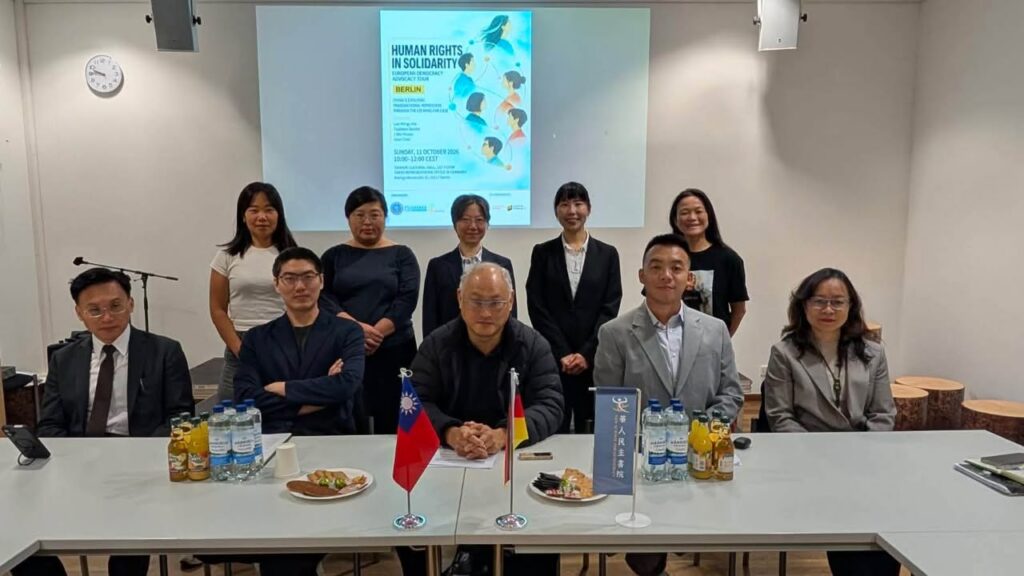
Four human rights workers drew on the experiences of Taiwan, Hong Kong and the Uyghur community to call for cross-border networks to protect victims and strengthen democratic cooperation
Date of release: 11 October 2026
The Berlin event of the “Human Rights in Solidarity: Lee Ming-che European Democracy Advocacy Tour” took place on the morning of 11 October at the first-floor Cultural Hall of the Taipei Representative Office in Germany. Under the theme “China’s Evolving Transnational Repression Through the Lee Ming-che Case,” four speakers, Lee Ming-che, Tashken Davlet, I-Min Hsiao and Ivan Choi, drew on their experiences as a target of political persecution, as members of exile communities and as human rights advocates to discuss the methods of China’s transnational repression, its impact on democratic societies, and the concrete steps Taiwan and Europe can take in response.
The discussion covered pressure on family members and intimidation carried out through private individuals, Uyghur forced labour and global supply chains, information manipulation targeting Taiwan, the security risks facing Hong Kongers overseas, and how to build protection systems centred on victims. From different angles, the four speakers pointed out that transnational repression does not only aim to silence particular individuals; through fear, isolation and mistrust, it can also shrink the space for public participation across an entire democratic society.
▌Lee Ming-che: Transnational repression works together with information manipulation, using families’ safety to silence people overseas
Lee Ming-che, a Taiwanese human rights worker who was sentenced by the Chinese government to five years in prison for “subversion of state power,” drew on his own experience of political persecution to explain that China’s transnational repression often begins with pressure on victims’ families. After his arrest in 2017, while he was cut off from the outside world, Chinese authorities approached his wife through “local collaborators,” threatened her with his personal safety, and demanded that the family neither speak publicly nor seek help from the Taiwanese government or non-governmental organisations. Lee said that since his release and return to Taiwan, many families of people detained in China have come to him for help, yet dare not speak out for fear that making their cases public will endanger their relatives.
Lee also cited cases in Taiwan: a boxing gym run by an exiled Hong Kong human rights worker was splashed with paint, a media figure critical of the Chinese government was attacked, and elected officials and prosecutors in Taiwan have been placed on wanted lists by Chinese authorities. He noted that China often carries out threats through private individuals, making it difficult to trace responsibility back to those behind them. Such incidents may also be accompanied by online rumours and information manipulation that erode trust in government, create social divisions and leave the targeted human rights workers isolated.
In his view, democracies cannot understand China-related activities through the logic of ordinary civil exchange; they need to recognise how tightly the Chinese government controls companies, social organisations and information.
On the legal response to transnational repression, Lee put forward the idea of a “presumption of guilt.” He noted that the justice systems of democracies are generally founded on the presumption of innocence, but because China often carries out transnational repression through private individuals, and because the Chinese government tightly controls information inside the country, it is difficult to obtain evidence and hold those behind such acts accountable.
Lee argued that for crimes or unlawful acts that benefit China, a “presumption of guilt” approach should be considered: unless the people involved are willing to disclose information according to the transparency standards of a democratic society and show that their actions have nothing to do with the Chinese government, it should be assumed that they are under the government’s control. He said that Taiwan and other democracies need to rethink their existing legal frameworks to respond effectively to the particular situation of China carrying out transnational repression through private individuals.
He also warned that the extraterritorial reach reflected in China’s Law on Promoting Ethnic Unity and Progress could further threaten the freedom of expression of people overseas. Lee called on governments to deepen their understanding of China’s mode of governance and its transnational repression, to provide protection through cooperation between public authorities and civil society organisations, and expressed the hope that the German government will not treat Taiwan as part of the People’s Republic of China, which would weaken the ability of Taiwanese people to resist transnational repression.
▌Tashken Davlet: Forced labour and surveillance technology are entering global markets, and cognitive warfare threatens democratic choice
Tashken Davlet, a Uyghur Taiwanese and second-generation exile, analysed the impact of China’s authoritarian system on the international community from three angles: forced labour, transnational repression and cognitive warfare. He pointed out that goods and raw materials linked to the forced labour of Uyghurs and other Turkic peoples may enter global supply chains, from cotton and solar panel materials to tomato products, which makes it necessary for European markets to confront the human rights risks in their supply chains. He also mentioned the activities of Chinese surveillance technology and drone companies in the European market, and urged democracies to strengthen procurement and supply chain scrutiny.
Tashken stressed that China’s pressure on people overseas does not end when they leave the country. He cited the detention of relatives of Uyghur advocate Rushan Abbas, threats from Chinese authorities against Taiwanese legislator Puma Shen, and the pressure faced by Laura Murphy, a scholar who researches Uyghur forced labour, as examples of how an authoritarian government can use families, legal and institutional means to influence dissidents, researchers and people engaged in politics abroad.
Turning to Taiwan’s democratic elections, Tashken said China-related information operations may influence public debate through social media platforms, disinformation and coordinated accounts. He argued that besides legislation and holding perpetrators accountable, democratic societies also need transparency of information, independent research, fact-checking and civic education, so that society can recognise attempts to manipulate public opinion and prevent global markets and technological cooperation from becoming channels through which authoritarian regimes extend their influence.
▌I-Min Hsiao: Countering perpetrators and supporting victims must be part of the same strategy
I-Min Hsiao, a Taiwanese human rights worker and Deputy Executive Director of Victim Support Taiwan, said that when an authoritarian regime threatens a person across borders, its aim is often to make many more people fall silent out of fear. Countering transnational repression therefore requires action on two fronts at once: stopping and holding perpetrators accountable, and helping victims regain their sense of safety and their autonomy.
Hsiao proposed four victim-centred policy directions: first, identifying patterns that may link online harassment, malicious litigation, economic pressure and threats against family members; second, providing digital security, legal assistance, psychological support, trustworthy reporting channels and protection for family members; third, respecting victims’ choices and helping them rebuild their lives and their ability to speak out; and fourth, building cross-border networks connecting governments, academia, civil society organisations and affected communities.
He noted that the victims of transnational repression assisted by civil society organisations in Taiwan do not all come from China; they also include members of the Belarusian democratic opposition, Vietnamese human rights lawyers and human rights workers who have fled Myanmar. Hsiao hopes this European exchange will lead to a long-term mechanism through which Taiwan and Europe share information, identify threats and provide practical assistance. He stressed that supporting victims is not passive charity, but an important strategy for weakening the intimidating effect of authoritarian governments.
▌Ivan Choi: Exile does not mean the end of resistance, and transnational repression is eroding the space of civil society overseas
Ivan Choi, Project Manager at New School for Democracy and a Hong Kong protester, looked back on his participation in the 2019 Anti-Extradition Law Amendment Bill Movement and his continued human rights advocacy after going into exile in Taiwan. He said that leaving Hong Kong changed the way he takes part in the resistance, but did not end his concern for and responsibility towards Hong Kong. Hong Kongers overseas still need to preserve the memory of resistance through organising, public discussion and international cooperation, so that Hong Kongers’ demands for freedom, democracy and political participation continue to be heard by the international community.
Choi shared that after leaving Hong Kong he has still been followed, secretly photographed and had his personal data leaked. While he was studying in Taiwan, the academic transcripts of Hong Kong students, including his own, were published by Huanqiu.com, a Chinese state media outlet, and used in a political smear. He said that threats like these make people constantly weigh whom they meet, whether to appear in photos, and whether public activities might implicate friends and family, which in turn undermines trust between people.
He also noted that at events organised by New School for Democracy, people have been found secretly photographing and monitoring participants; according to the organisation’s subsequent investigation, some of these incidents involved commissions from China and Hong Kong carried out through Taiwanese private investigation firms. While organising June Fourth commemorations, the organisation has also received threatening messages, including threats of random killings and bomb attacks. The Pillar of Shame by Danish artist Jens Galschiøt, rebuilt in Taiwan with 3D printing in 2022, was vandalised with spray paint that same year. In his view, transnational repression does not only violate personal privacy and safety; it also forces organisations to divert resources to security, shrinking the space for preserving history, advancing civic education and free participation.
Choi called on Europe to continue paying attention to Hong Kong’s political prisoners and people facing persecution, to raise human rights issues in dealings with the Chinese and Hong Kong authorities, and to establish trustworthy channels for help as well as legal, psychological and security support. “The responsibility for ensuring safety cannot rest on the courage of those affected alone,” he said. Democratic societies have a responsibility to ensure that people are not threatened for peacefully expressing political views, taking part in commemorations or meeting friends.
▌From individual cases to institutional cooperation: building a democratic line of defence across borders
The experiences of the four speakers show that transnational repression can simultaneously involve threats to personal safety, pressure on families, data leaks, supply chains and surveillance technology, information manipulation, and a chilling effect on public participation. Responding to these threats cannot be limited to handling each incident after it happens; it also requires recognising patterns of action, building protection and reporting systems, and ensuring long-term support for those affected and for civil society organisations.
Taking Taiwan’s experience of facing transnational repression as its starting point, the Berlin event aims to continue promoting exchange between civil society, research institutions and the public sector in Taiwan and Europe, turning concern about political persecution into concrete action on victim protection, information cooperation and civic education.
── Event Information and Media Contact ──
Event: Human Rights in Solidarity: Lee Ming-che European Democracy Advocacy Tour, Berlin
Time: Sunday, 11 October 2026, 10:00–12:00 (German time)
Venue: First-floor Cultural Hall, Taipei Representative Office in Germany (Markgrafenstraße 35, 10117 Berlin)
Organizers: New School for Democracy, Taiwan Association in Sweden, Kulturverein Ananasli, Walking for Taiwan Association in Europe
Co-organizers: Junge Taiwan Initiative, Freiheit für Hongkong e.V.
Media contact: Ivan Choi | kelly@nsd.asia