Taiwanese and Hong Kong Civil Society Speak Out Together on 1 October, from Human Rights in Hong Kong and Transnational Repression to Defending Taiwan’s Democracy
Release date: 1 October 2026
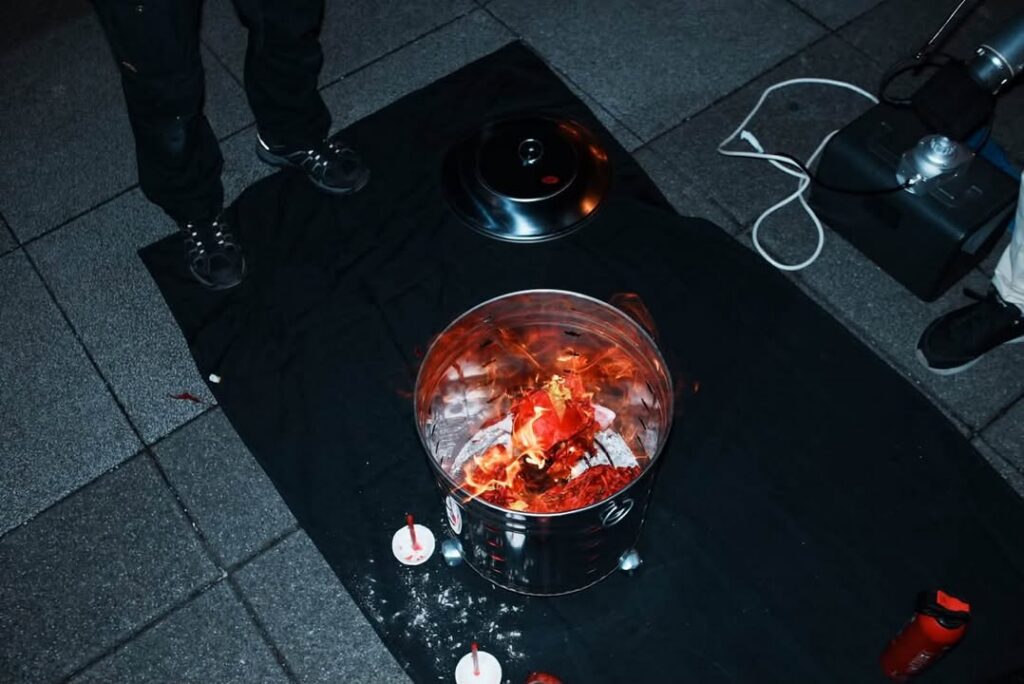
On the evening of 1 October, Hong Kong Outlanders, New School for Democracy and the Hong Kong Human Rights Front held the “Taiwan and Hong Kong United Against Totalitarianism” rally at Liberty Square in Taipei. Under the theme “No Celebration for Totalitarianism,” the rally used a street performance of the traditional Hong Kong “villain hitting” ritual, a collective lighting of lights, and speeches by representatives of Taiwanese and Hong Kong civil society to draw attention to human rights in Hong Kong, political persecution, transnational repression, the expansion of authoritarianism, and the security of Taiwan’s democracy.
Hong Kong exiles, human rights workers, civic groups and a survivor of the June Fourth Incident spoke together at the rally. Speakers said that the rapid shrinking of freedom in Hong Kong in recent years should not be seen as Hong Kong’s problem alone: as authoritarian influence and transnational repression cross borders, Taiwan and other democratic societies must also confront the risks they bring.
The rally opened with the Hong Kong folk tradition of “villain hitting” reworked as street theatre. Xi Jinping, John Lee and Chris Tang, along with politicians including Fu Kun-chi and Weng Hsiao-ling, were named as symbolic targets, and rhyming lines in Cantonese criticized the national security legal regime, political repression, transnational repression, control of the press and of speech, surveillance, and the shrinking of cultural space.
The performance ended by “burning the villains and welcoming democracy’s benefactors,” and set out demands including “Cast off autocracy, embrace the rule of law and freedom,” “Transparent government, real civil rights,” “A fair judiciary that protects the public good,” and “Universal suffrage, so democracy and freedom can take root,” turning a Hong Kong folk custom into a form of public action and collective memory.
Fu Tang, founder of the Hong Kong Human Rights Front, looked back on his involvement in Hong Kong’s social movements since 2014, through street protests and court cases, until he was forced into exile in Taiwan in 2021. He said he had watched with his own eyes as Hong Kong changed rapidly from a diverse, free city into its political environment today, and that even after leaving Hong Kong for Taiwan he had faced intimidation and harassment.
Fu Tang said some people may believe they can stay safe as long as they avoid politics and do not oppose the government, but Hong Kong’s recent experience shows otherwise. Under authoritarian rule, he said, it is not only political opponents who are restricted; the public expression and rights of ordinary citizens can be affected as well.
“This autonomy is not something to be taken for granted. It needs the whole of society to defend and protect it,” he said, adding that he would stay here and keep working alongside Taiwanese society.
Chang Yu-meng (張育萌), chairperson of the 世代共好協會, said some people in Taiwan still believe in “not provoking China,” which he called a naive fantasy. Hong Kong’s experience has already shown that although China promised that “one country, two systems” would remain unchanged for fifty years, that promise could still be overturned quickly.
Chang said China keeps developing new means of transnational repression, exposing Taiwanese people, Hong Kongers, and indeed any citizen who supports democracy, freedom and human rights to risks to their personal safety.
He also criticized Taiwan’s legislature for actions over the past two years that echoed China’s policies, including blocking a requirement for legislators to report trips to China and related national security bills. China’s infiltration of Taiwan, he said, is no longer only information warfare; it also includes real influence on Taiwanese society and the risk of violence.
“As Taiwanese, faced with such an overbearing dictatorship, all we can do is keep resisting,” Chang said, adding that partners across democratic societies must keep walking together to resist the CCP’s expansionist ambitions.
Ivan Choi, Project Manager at New School for Democracy and a Hong Kong-born human rights worker in Taiwan, said he was born and raised in Hong Kong and lived through the step-by-step shrinking of its freedoms. Freedom, he said, rarely disappears overnight; it is taken away gradually, through one restriction after another, through fear and self-censorship.
He said that coming to Taiwan from Hong Kong had given him a deeper understanding of “freedom.”
“I used to think freedom meant having the right to do things. Now I feel more and more that freedom is not only a right but also a responsibility.”
Choi said that people who live in a society where they can still speak freely, assemble and criticize their government do not only enjoy these rights; they also have a responsibility to protect that space and to keep alive the voices of those who have already lost the chance to speak.
He said New School for Democracy has long worked to preserve the memory of June Fourth, follow political persecution, promote human rights education and international advocacy, and track transnational repression. Hong Kong’s experience is not only a memory for Hong Kongers; it should serve as a mirror through which Taiwan understands authoritarianism.
“Because I come from a place where people also once thought these things were perfectly ordinary,” Choi said. That, he explained, is why he understands so clearly that the space Taiwan has today to talk openly about political persecution, June Fourth, Hong Kong and transnational repression can never be taken for granted.
Lawyer Chen Yen-hsuan (陳彥亘), deputy convener of the international group at the Judicial Reform Foundation, said Hong Kong’s use of national security law in recent years against June Fourth commemorations, political expression and related cases shows that freedom of speech, the judicial environment and civil society in Hong Kong remain under pressure.
He said authoritarian pressure has not stopped at Hong Kong’s border. Exiled Hong Kongers, human rights advocates, journalists and civic groups in Taiwan may also face transnational repression in the form of surveillance, harassment and threats.
Chen called on Taiwan’s government to establish a dedicated mechanism against transnational repression as soon as possible, including complete legal tools, reporting channels for victims, training, risk protection, and systems of personal and everyday support.
He also revealed that the Judicial Reform Foundation began field interviews and in-depth research this year with victims of transnational repression in Taiwan, and expects to publish a report and hold a conference at the end of the year.
“Freedom has never been something to take for granted. Only by watching out for one another can we hold democracy’s line of defense,” Chen said.
Former Sham Shui Po District Councillor Lee Man-ho (李文浩) said that 1 October was also his 1,026th day as a wanted man. Over more than a thousand days, despite intimidation, smears and repression aimed at him and those around him, he has chosen to keep speaking out publicly.
Recalling the 2019 Hong Kong District Council elections and the later disqualification of elected councillors, Lee said this showed the CCP’s fear of people making their own political choices. “Faced with the CCP, as long as we are not afraid, they are nothing,” he said.
He said that every time he posts on Facebook since coming to Taiwan, he still receives messages from neighbors in Hong Kong telling him that many things can no longer be said publicly there and asking him, from overseas, to speak for them.
For that reason, he said, the rally was not only a chance for diaspora Hong Kongers to express their own positions but also a way to speak for those still in Hong Kong who cannot speak freely. “We are not only expressing our own voices; even more, we are speaking for the Hong Kongers who are still holding on in Hong Kong.”
Human rights worker Lee Ming-che spoke on “China’s National Day, the World’s Disaster,” describing how China’s authoritarian rule has affected Uyghurs, Tibetans, Hong Kong and other communities.
Lee said Hong Kong’s experience should be a particular warning to Taiwan. China made political and legal commitments regarding Hong Kong, but what happened to Hong Kong afterwards is reminder enough that Taiwan cannot build its security on trust in China’s political promises.
He also discussed the spread of China’s model of surveillance and governance abroad, citing the Solomon Islands and several countries in Asia, Africa and the Middle East. The outward reach of Chinese power, he argued, brings not only economic and military influence but also the export of surveillance technology and authoritarian models of governance.
Lee said China’s actions in the Taiwan Strait, the South China Sea and the East China Sea also keep neighboring countries under constant security pressure. The problems brought by China’s rise, he said, must be understood together from the perspectives of human rights, democracy and regional security.
Sang Pu, chairperson of the Taiwan Hong Kong Association, said that in the face of ongoing human rights abuses in Hong Kong, the most important thing is to “refuse to forget” and to keep paying attention to the concrete circumstances of every person who has been persecuted.
He said some people in Taiwan may think what happens in Hong Kong has nothing to do with them, but only by understanding these concrete cases can people see more clearly how an authoritarian system restricts the press, publishing, culture, speech and civil society.
Citing recent cases in Hong Kong involving journalists, ordinary citizens, bookshops and political prosecutions, Sang Pu said that beyond direct criminal prosecution, the self-censorship and chilling effect created by vague legal boundaries and political pressure also deserve attention.
“Don’t think Hong Kong is dead, and don’t think what happens in Hong Kong has nothing to do with you. It has everything to do with you,” he urged.
Sang Pu also thanked Taiwanese society for having taken in Hong Kong protesters, and called on Taiwan to keep cherishing its democracy and freedom and to care for those suffering political persecution.
Fung Chiu-tin (馮詔天), secretary-general of Hong Kong Outlanders, spoke about the “villain hitting” ritual performed that evening and about the cultural memory and sense of self of diaspora Hong Kongers.
Holding a traditional ritual, he said, is not about believing that a few slogans or a single ceremony can bring down totalitarianism. It is about letting Hong Kongers, amid diaspora and trauma, know through familiar language, culture and shared memory that they are not alone, and find the strength to keep going.
Fung noted that seven years have passed since 2019, and many Hong Kongers who came to Taiwan have gone on to study, work, start businesses and raise families, finding a place for their lives here. Being able to settle down is something to be grateful for, he said, but the diaspora community must keep asking: “And then what?”
“Settling down and finding emotional comfort should only be the starting point on our road to democracy, not the end,” he said.
On transnational repression, Fung said the authoritarian regime’s continued pressure on Hong Kongers overseas shows that it still matters for the diaspora to stay connected, speak out and preserve the memory of freedom.
He described the long struggle as “a marathon of a lifetime,” stressing: “We can rest, but we cannot stop.”
Fung closed by saying that being a Hong Konger should not stand only for trauma and loss, but also for resilience, courage and an unyielding pursuit of freedom. “This marathon is still long, but as long as we keep running, the story of Hong Kongers is not over.”
Wu Renhua, a June Fourth survivor and historian, said he has long been deeply grateful for the free environment and support Taiwan has given him.
As a witness to June Fourth and a long-time researcher of Chinese politics, he said that in recent years he has also felt that China’s influence on and infiltration of Taiwan call for a high degree of vigilance. Seeing so many people in Hong Kong lose their freedom over political cases, he said, has been deeply saddening.
Wu said that everything from June Fourth to Hong Kong today has made him understand ever more deeply how precious freedom and democracy are. He hopes to keep using his many years of experience researching the CCP and understanding China’s political system to do his part in helping Taiwan resist authoritarian influence and defend its democracy and freedom.
The organizers said that “Taiwan and Hong Kong United” should not stop at solidarity with Hong Kong. It should make Hong Kong’s experience an important point of reference for Taiwan in understanding authoritarianism and transnational repression, and make Taiwan’s existing democratic space a platform where diaspora Hong Kongers can keep preserving memory, connecting with one another and speaking out in public.
As authoritarian influence crosses borders, Taiwanese and Hong Kong civil society need all the more to keep building ties with each other, to preserve memory together within a democratic society, to resist fear, and to defend the space for freedom that was so hard to win.
Co-organizers: Hong Kong Outlanders, New School for Democracy, Hong Kong Human Rights Front