Sharing Taiwan’s and Hong Kong’s experience of transnational repression, calling for the protection of human rights and Taiwan–EU cooperation
Date of release: 13 October 2026 | Brussels, Belgium
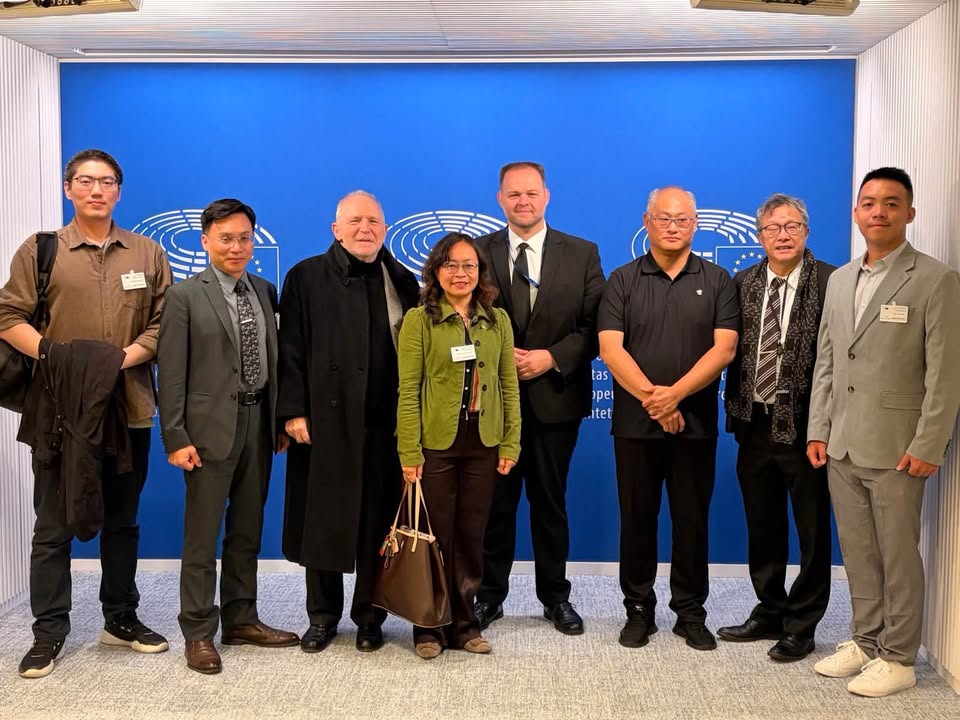
On 13 October, the delegation of New School for Democracy’s “Human Rights in Solidarity: Lee Ming-che European Democracy Advocacy Tour,” led by Ambassador Jhy-Wey Shieh, met with Members of the European Parliament. The meeting was chaired by MEP Bernard Guetta and attended by MEP Engin Eroglu. Delegation members Lee Ming-che, I-Min Hsiao, Tashken Davlet, Ivan Choi and Alicia Wu drew on their experiences of political persecution, judicial reform, the situation of the Hong Kong diaspora and information warfare to explain how China’s transnational repression affects democratic societies. They urged the MEPs to protect human rights workers, follow up on the European Parliament’s resolution on Hong Kong, and deepen cooperation between Taiwanese and European civil society.
MEPs Bernard Guetta and Engin Eroglu listened to the delegation and discussed with them the situation Taiwan faces under pressure from China. In their responses, the MEPs drew parallels between the situation across the Taiwan Strait and that between Russia and Ukraine, asked about Taiwan’s assistance to Ukraine, and raised questions about how Taiwan is responding to transnational repression and Chinese infiltration. These questions led to a discussion on social solidarity, victim protection and cooperation in research on information warfare.
Lee Ming-che began by thanking the European Parliament for its past support during his detention in China. He pointed out that transnational repression does not only target public advocates; it can also work through threats against family members, local collaborators and information manipulation, leaving victims and their families too afraid to seek help or reveal the truth. Drawing on his own detention, he described how the Chinese government used local collaborators to threaten his wife with his safety, demanding that she stop speaking publicly and cut off contact with the Taiwanese government and civil society groups.
Lee said that since his return to Taiwan, families of other people detained in China have also asked him for help. Besides worrying about their relatives’ situation, they fear that making the cases public or seeking help from the Taiwanese government will bring harm to their families. Silencing people by threatening their relatives’ safety prevents the outside world from learning the truth and leaves human rights workers isolated. He called on democracies to provide the necessary protection through public authorities, to work with NGOs, and to use public discussion and social solidarity so that people under threat can safely seek help and continue to take part in public life.
Asked by the MEPs how Taiwan is responding to Chinese infiltration and transnational repression, I-Min Hsiao replied: “The resistance of Taiwanese people is partly visible and partly invisible.” Citing his work on protecting victims of crime, he explained that China tries to exploit criminal incidents, using information operations to amplify public distrust of the government and the judiciary and to divide Taiwanese society. Providing better protection and support to victims, and building a society in which people help and trust one another, is therefore also part of the everyday defence of democracy.
Hsiao also used Lee Ming-che’s case to illustrate forms of resistance that are not easily seen. For years Lee introduced Taiwan’s democratic experience to people in China online, and organised a support network of more than 500 people that raised donations to regularly help the families of imprisoned Chinese political prisoners meet their basic needs. Hsiao said that this kind of democratic exchange and civic mutual aid across borders lets families suffering political persecution know they are supported. He stressed that China’s threat to Taiwan is not only a military issue; it directly affects people’s freedom, democracy and human rights, and judicial reform, victim protection and human rights work are all part of resisting authoritarianism.
Ivan Choi focused on the role of the Hong Kong authorities in transnational repression. He thanked the European Parliament for adopting its 2024 resolution on Hong Kong and noted that the Hong Kong authorities may use Hong Kongers travelling to Taiwan to carry out surveillance, apply pressure or disrupt activities, which the governments concerned should investigate seriously. He also pointed out that the Hong Kong authorities carry out transnational repression on Beijing’s behalf while still benefiting from the international trust built up in the past, and called on Europe to review the treatment it gives Hong Kong government bodies and the risks of cooperating with them. Choi put forward three requests: that the EU continue to follow up on the 2024 Hong Kong resolution and assess how each of its demands has been implemented; that it review the status of the Hong Kong Economic and Trade Offices and the risks of sharing sensitive data and cooperating on law enforcement with the Hong Kong authorities; and that it provide safe reporting channels and practical support for people under threat, while promoting exchange of experience between Taiwan and Europe in handling such cases. He hopes to protect the freedom and safety of Hong Kongers while holding the people and institutions involved in repression accountable, and to push for concrete follow-up action.
Choi stressed that identifying transnational repression must be based on specific conduct and evidence; being a Hong Konger should never in itself be grounds for suspicion, and many people came to Taiwan precisely for freedom and safety. But if someone uses ordinary travel and entry channels to carry out repression on a government’s behalf, democratic societies need mechanisms to identify and respond to it. He also briefly shared his own experience of being followed and secretly photographed in Taiwan, illustrating how transnational repression affects the lives and public participation of people in the diaspora.
Tashken Davlet proposed that beyond private donations and government aid, Taiwan–Europe cooperation could also develop more structured partnerships between NGOs. He pointed out that Russia’s information warfare against Ukraine and China’s against Taiwan use similar methods of narrative manipulation. For example, on Chinese social media platforms, narratives aligned with Russia’s are used to justify its aggression, which could serve as a case for cross-regional research and information exchange. Taiwan can share with Europe its experience of information warfare, manipulation through fake accounts, and identifying and countering disinformation, to help understand and guard against these threats.
Drawing on Taiwan’s democratic development and her experience of living in Sweden, Alicia Wu addressed the authoritarian pressure on Taiwanese identity, freedom of expression and press freedom. She shared her experience of being harassed while supporting Taiwanese sports and cultural events, and called on the EU to pay attention to how Taiwan is labelled in administrative data systems, so that residents are protected from transnational harassment. She also raised information manipulation and the security of critical infrastructure, stressing that human rights and security deserve attention.
Lee Ming-che emphasised that Taiwan faces not only China’s military threat but also covert and powerful transnational repression. He said he is willing to share Taiwan’s experience of facing China’s transnational repression with the world, and called on the European Parliament to urge the EU not to treat Taiwanese people as nationals of the People’s Republic of China, which would amount to helping China carry out transnational repression against them. He also proposed that in its human rights dialogue with China, the EU should address extraterritorial prosecution, overseas police stations and the impact of transnational repression on democratic societies. Through this exchange, the delegation hopes to bring the human rights experience of Taiwan and Hong Kong into European policy discussions and to build connections for future information exchange, victim protection and civil society cooperation.
In his closing remarks, Ambassador Jhy-Wey Shieh thanked MEPs Bernard Guetta and Engin Eroglu for receiving the human rights workers and NGOs from Taiwan and for listening to their experiences and requests. The meeting showed how important it is for democratic societies to safeguard free exchange, criticism and public participation, and underlined the need to protect those under threat. In the face of transnational repression, only by supporting human rights workers and diaspora communities through civic education, public discussion and cross-regional cooperation can the space for free participation be preserved. For Taiwan, defending Taiwan means protecting human rights.
Media contact: Ivan Choi
Project Manager, New School for Democracy
Email: kelly@nsd.asia