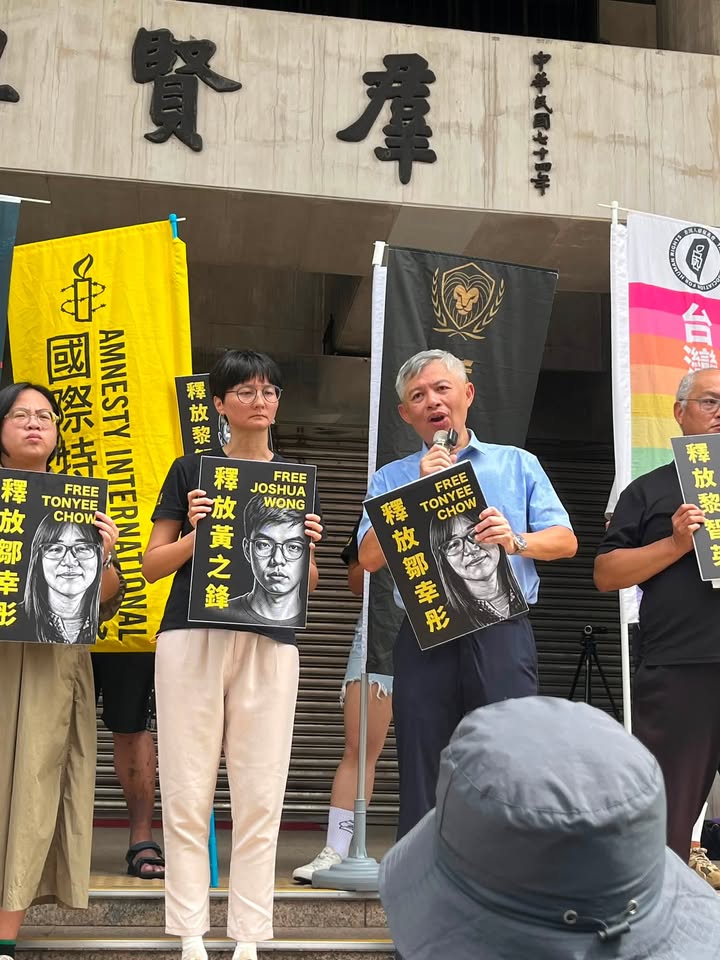
Remarks by Kung Chin-lung, Secretary-General of the New School for Democracy Association, at the press conference held by Taiwanese civil society groups outside the Legislative Yuan in solidarity with Joshua Wong, on the day of his plea and sentencing under the national security case against him.
Friends from the media, friends who care about human rights in Hong Kong, good morning. I am Kung Chin-lung, Secretary-General of the New School for Democracy Association.
Today, as we speak here outside Taiwan’s Legislative Yuan, at this very moment Joshua Wong is once again facing trial under the Hong Kong National Security Law in a Hong Kong court.
Joshua Wong is already imprisoned for taking part in the pro-democracy primaries. He now faces a further charge of conspiracy to collude with foreign or external forces to endanger national security. At its most severe, this charge could mean life imprisonment.
We must state clearly: explaining the human rights situation in Hong Kong to the international community is not a crime. Calling on other countries to pay attention to Hong Kong’s freedoms and rule of law is not “collusion with foreign forces.” When a government defines peaceful political participation, international advocacy and dissenting views as threats to national security, what is truly threatened is not national security, but the most basic freedoms and rights of its people.
The Hong Kong government’s prosecution of Joshua Wong is not directed at one person alone. The message it sends is that anyone who continues to talk about Hong Kong, to seek international attention, or even simply to speak up for political prisoners from abroad, could be the next to be pursued. This is precisely how the Hong Kong National Security Law manufactures fear and extends its chilling effect.
The New School for Democracy has long followed human rights and democratic development in Hong Kong, China and Taiwan. We know well that what authoritarian regimes most wish to see is people falling silent out of fear, the names of political prisoners gradually forgotten, and the history of repression disappearing from public memory.
That is why we are here today — not only to speak for Joshua Wong, but for all the political prisoners still held in Hong Kong. Whether Joshua Wong, Jimmy Lai, Chow Hang-tung, Lee Cheuk-yan, or others imprisoned for pursuing democracy and defending freedom, none of them should be forgotten by the world.
We also call on the government of Taiwan not to confine itself to expressing regret after a verdict. As a democratic society, Taiwan should condemn more clearly the Hong Kong government’s use of national security legislation for political persecution, continue to follow the trials, sentences and prison conditions of political prisoners, and work with the international democratic community to build more concrete mechanisms of solidarity and protection.
Finally, we again call on the Hong Kong government to drop all charges against Joshua Wong, to release him and all Hong Kong political prisoners immediately and unconditionally, and to stop using the Hong Kong National Security Law and the Safeguarding National Security Ordinance to suppress peaceful advocacy and fundamental human rights.
Freedom is not a crime, and advocating for democracy is not collusion.
Joshua Wong and all Hong Kong political prisoners are not alone. For as long as they remain imprisoned, we have a responsibility to keep remembering, to keep speaking out, and to keep calling on the international community to act.
Thank you.