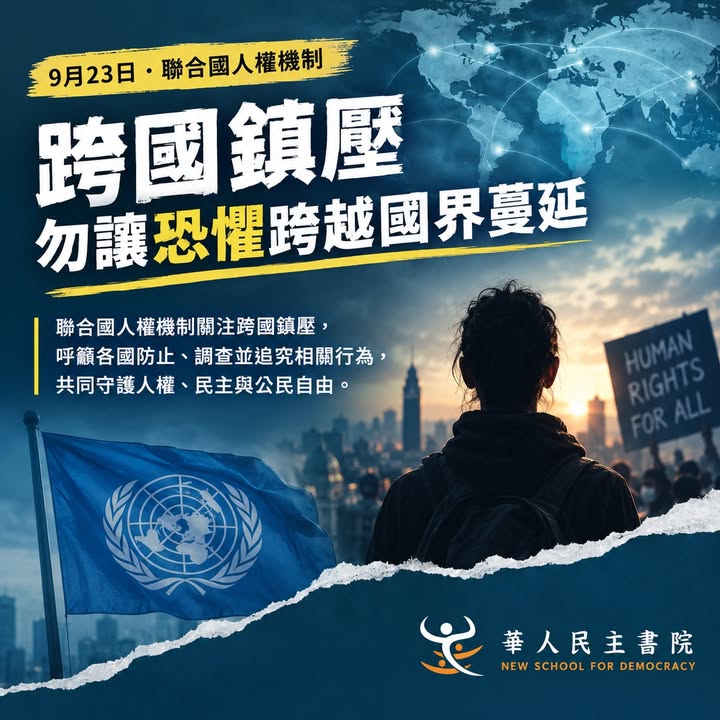
On 23 September, United Nations human rights mechanisms issued a joint statement on transnational repression, expressing deep concern over this increasingly serious form of human rights violation and its impact on democracy, human rights, civic space and the rule of law.
The statement describes transnational repression as acts carried out by states, within or beyond their own territory, against individuals, groups and communities abroad — silencing, intimidating, punishing, coercing or otherwise harming them because of their opinions, identity or activities, particularly the expression of dissent, human rights advocacy, and work for democracy and the rule of law.
Those who carry out transnational repression are not necessarily states themselves. It may also be conducted through non-state actors directed, controlled or assisted by a state, and assistance and cooperation between states can likewise form part of it. Those affected include not only human rights defenders, dissidents, journalists, civil society groups and students, but also migrants, asylum seekers, refugees and diaspora communities. The methods are equally varied: threats, harassment, criminalisation, arbitrary detention, enforced disappearance, and the abuse of extradition and international law enforcement cooperation mechanisms can all serve as instruments of transnational repression.
As technology advances, transnational repression is also becoming increasingly digital. Social media and messaging platforms may be used for stigmatisation, smear campaigns, online harassment, threats and disinformation, while spyware and malware may be used to conduct surveillance or otherwise violate human rights. Deepfake imagery generated by artificial intelligence further compounds these risks.
The statement emphasises that transnational repression does not only harm its direct victims. Through fear, it produces a broad chilling effect that undermines civic and political participation, freedom of expression, peaceful assembly and association, and press and academic freedom.
Crucially, international human rights law and international refugee law apply equally to conduct associated with transnational repression. States have an obligation to refrain from carrying out or assisting such acts, a responsibility to protect individuals and groups within their jurisdiction from foreseeable transnational repression, and a duty to ensure that victims have access to effective remedies.
The statement underlines once again that transnational repression has become an issue of growing importance within the international human rights system.
When threats and fear attempt to cross borders, it becomes all the more necessary to hold the line on human rights, democracy and civil liberties.
The New School for Democracy supports this statement and firmly opposes transnational repression in all its forms. We call on governments to actively prevent, investigate and hold to account acts of transnational repression, so as to safeguard everyone’s right to exercise their human rights and freedoms, at home and abroad.