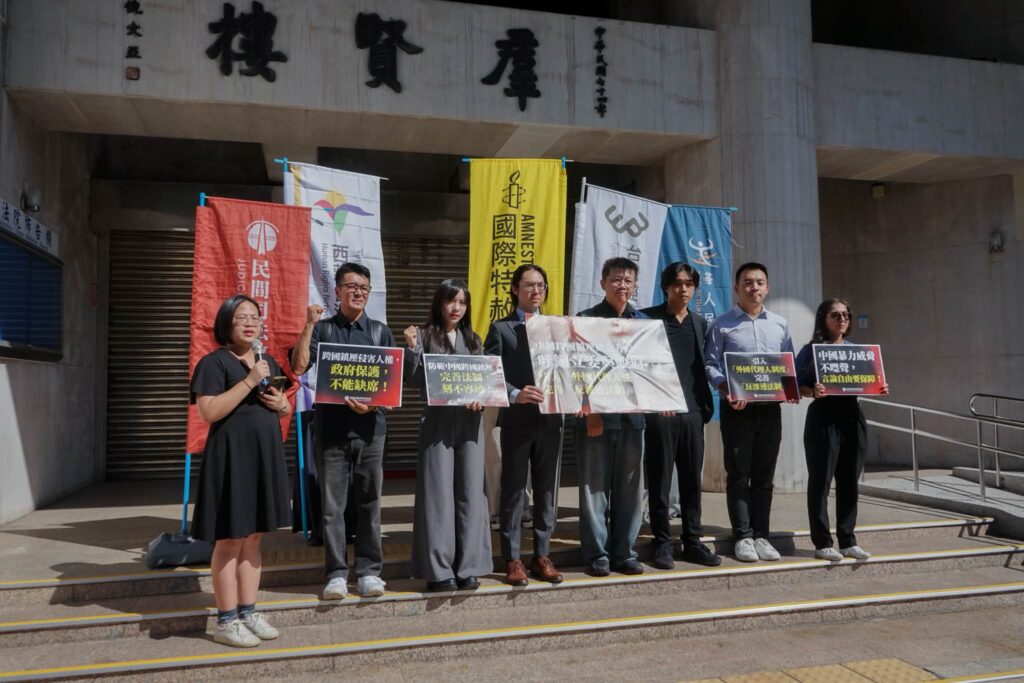
Remarks by Ivan Choi, Project Manager, New School for Democracy
30 October 2026
Hello to our friends from the media and to everyone here today. I am Ivan Choi, a Hong Kong activist and Project Manager at New School for Democracy.
I took part in Hong Kong’s 2019 anti-extradition movement. I later came to Taiwan, and I am now a Taiwanese citizen. Today I speak as a human rights worker, and as someone who has been affected by transnational repression, in support of the government and the Legislative Yuan moving swiftly to strengthen the relevant laws.
Since leaving Hong Kong, I have still been followed and secretly photographed, and my personal information has been leaked. While I was studying in Taiwan, the academic transcripts of Hong Kong students, including mine, were published by Huanqiu.com, a Chinese state media outlet, and used to smear us politically. These experiences taught me that even after leaving Hong Kong, the threat can still reach into our lives, and it affects the sense of safety of the friends around us.
New School for Democracy faces the same pressure. People have come to our events to secretly photograph and monitor participants. According to the organisation’s own follow-up checks, some of these incidents involved Chinese and Hong Kong parties acting through Taiwanese private investigation firms. Our June 4th commemorations have received threats of random killings and bomb attacks, and the Pillar of Shame we rebuilt in Taiwan has been vandalised with spray paint.
Incidents like these affect whether a person is willing to keep speaking out, and whether others dare to attend events, make their identities public or get in touch with us. Civil society organisations also have to commit extra staff and resources to security before they can continue their work in civic education, preserving history and defending human rights.
That is why, when we look at what happened to Mr Huang Yi-hao, we understand all too well the threat this violence brings. According to the indictment, someone allegedly funded and instructed people in Taiwan to follow him and ram him with a vehicle, in an attempt to injure him so that he could no longer perform.
This case also sends a threat to everyone who publicly criticises the Chinese government: even in Taiwan, you may face retaliation for what you say. When people speak less or withdraw from public life as a result, Taiwan’s freedom of expression and democratic participation suffer real harm.
So I support closing the gaps in our laws against transnational repression, and I call on legislators from all parties to share this responsibility. Protecting people from political violence should be common ground in a democratic society.
Existing law can deal with some acts of injury, intimidation, property damage and unlawful collection of personal data. But we need more complete provisions to address foreign forces that, through instructions, commissions and funding, suppress other people’s exercise of their rights in Taiwan.
Accountability must also go beyond the people who carry out these acts, and follow the trail upward to those behind the orders and the funding, as well as the networks assisting them, so that the same commissioning model cannot keep finding new people to do the work. As for proposals such as a foreign agent registration system, we look forward to the government and the Legislative Yuan openly discussing the specific design, clearly defining who it applies to, what conduct it covers and how it will be overseen.
Drawing on my own experience and that of New School for Democracy, I would like to put forward three requests.
First, make sure protection actually reaches the people under threat.
The government has set up a cross-agency coordination platform and begun to take measures including case-by-case protection, investigations and outreach to businesses. This progress deserves recognition. The next step is to make sure the public clearly knows how to use these mechanisms when problems arise.
When someone is followed, secretly photographed or intimidated, there should be a trustworthy place to turn for help, with people who can help preserve evidence, assess the risk and keep following up. Those affected are often unable to find out who is behind it, so the system must be able to take up these concrete concerns and provide help in time.
Support should also cover people who do not yet hold Taiwanese citizenship, as well as the civil society organisations that assist them and host events. Legal, psychological and security support all bear on whether we can continue to live and work.
Second, make prevention accurate in identifying risk.
We support the government in reviewing entry declarations and checks, and in strengthening its ability to identify people who pose risks of repression, intelligence gathering or violence. We also support continuing to improve private investigation firms’ ability to recognise, refuse and report suspicious commissions, so that legitimate services cannot be used to monitor and harm others.
But risk assessments must rest on concrete evidence. Being from Hong Kong cannot in itself be treated as proof of danger, and when someone is wanted or convicted in Hong Kong, it must be examined whether this involves political persecution. We hope the system will be able to tell apart people who have been persecuted from people who take part in persecution.
Third, involve affected communities and keep track of how policies are carried out.
Hongkongers, as well as Tibetan, Uyghur and other communities persecuted by authoritarian regimes, can share their practical experience to help the government understand how threats arise, what difficulties people meet when seeking help, and which measures may harm the wrong people.
We hope these experiences will feed into consultations on legal amendments and into policy design. We also hope the government will set out a clear timetable for the amendments, protection procedures and resources, and, while protecting the privacy of those concerned, allow the public to review how they are put into practice.
As someone who came to Taiwan from Hong Kong, I deeply value the freedom here to criticise the government, to take part in assemblies and to discuss human rights openly. I also hope that everyone living here can enjoy these freedoms without fear.
I will continue to speak out publicly and continue my human rights work. New School for Democracy will also keep pushing forward its advocacy on these issues. But personal safety should not depend on the courage of those affected, nor can it be left to civil society advocacy groups to carry alone.
We therefore call on the government and the Legislative Yuan to take concrete action to strengthen and put into practice a protection system that truly works, so that everyone under threat knows: when we choose to keep speaking out and keep taking part in public life, there is a system we can rely on and laws that protect us.
Defending freedom should not leave those who speak out to bear the risk alone, and protecting human rights cannot remain a slogan.
Thank you.